Commercial pest management addresses high-risk pest vectors across mixed-use, hospitality, and retail spaces where localized humidity accelerates pest reproduction. In coastal environments like West Palm Beach, dense…
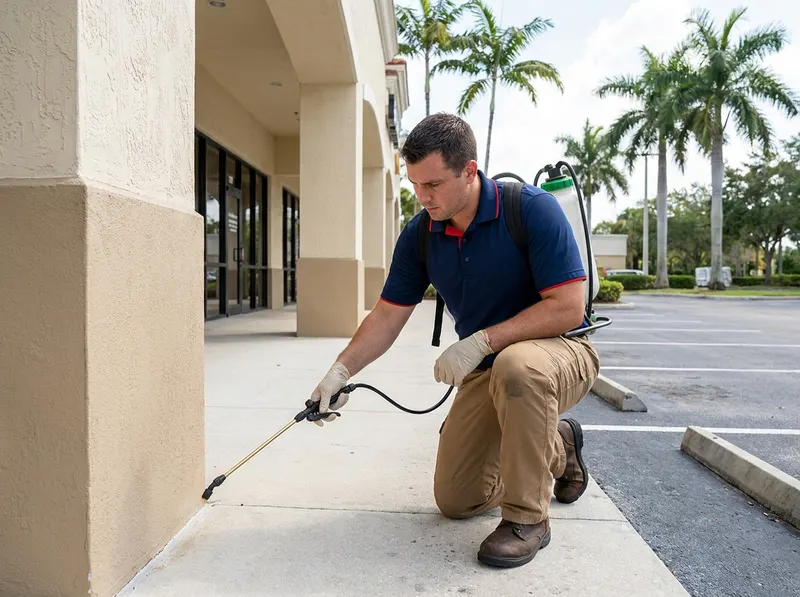
Commercial pest management addresses high-risk pest vectors across mixed-use, hospitality, and retail spaces where localized humidity accelerates pest reproduction. In coastal environments like West Palm Beach, dense palm canopies and continuous warmth drive pests toward commercial interiors. A restaurant along the Clematis Street Historic District facing recurring German cockroach activity requires high-heat steam extraction and non-volatile baits rather than broad surface sprays, which fail when grease films accumulate. Conversely, a multi-tenant logistics park near the Villages of Palm Beach Lakes demands continuous exterior rodent monitoring and loading-dock exclusions. Structural integrity relies on clear regulatory alignment, such as the sanitation standards outlined by the Florida Administrative Code and regulatory food-handling guidelines published by the U.S. Food and Drug Administration. SecureHive Pest Management utilizes strict Integrated Pest Management protocols aligned with the Environmental Protection Agency to stop pest migration before domestic inventory or customer-facing spaces are compromised.
Operational risks increase when facility managers rely on consumer over-the-counter pesticides, which disperse colonies deeper into insulated walls rather than eliminating the nesting harborage. Facilities operating within historic sectors like El Cid, Northwood Village, and Grandview Heights frequently contend with structural settling, cracked mortar joints, and older plumbing pipe penetrations that serve as natural entry pathways for American cockroaches and roof rats. Establishing a physical barrier requires sealing gaps exceeding one-quarter inch using metal mesh and copper wool under guidelines monitored by OSHA. Facilities subject to commercial retail safety expectations established by the Centers for Disease Control and Prevention benefit from perimeter monitoring stations spaced every 30 to 50 feet along exterior foundations, preventing outdoor vectors from crossing into storage zones.
Corporate suites in Southland Park, retail storefronts in Providencia Park, and medical offices along Palm Beach Lakes Boulevard necessitate discrete, low-toxicity applications that maintain indoor air quality during business hours. Compliance with Florida Department of Agriculture and Consumer Services licensing benchmarks guarantees that every chemical application respects strict commercial thresholds without exposing staff, customers, or domestic pets to airborne residues. Exterior barriers deployed around properties near Breakers West or along coastal borders in SoSo (South of Southern) must withstand heavy seasonal rainfall; synthetic microencapsulated pyrethroids adhere to concrete footings and brick facades, retaining residual efficacy for up to 60 days even through severe subtropical downpours. By tracking structural risk markers referenced by the U.S. Fish and Wildlife Service, treatment perimeters avoid disturbing non-target wildlife habitats in adjacent zones like Grassy Waters Preserve or wetlands surrounding the Palm Beach Zoo & Conservation Society.
Selecting professional facility defense prevents expensive shutdowns, lease turnover delays, and public health citations. Treatment methods follow technical parameters vetted by industry authorities such as the National Pest Management Association and pest research guidelines from the Department of Entomology at Texas A&M University. Facility operators balance immediate pest knocking power with non-disruptive placement: bait matrices target foraging worker ants, insect growth regulators disrupt larval cycles without emitting foul odors, and mechanical multi-catch traps secure interior perimeters silently. Clear service records, floor plan schematics, and chemical application logs satisfy third-party auditors and local municipal inspectors governed by the Palm Beach County Government, ensuring commercial operations remain uninterrupted and completely free of damaging infestations.
Every job gets a firm, written price after a free on-site visit.
For standards, safe disposal, and service guidance on pest control services in West Palm Beach, FL, useful references include U.S. EPA, ENERGY STAR, U.S. Dept. of Energy, Consumer.gov, U.S. Census Bureau, and Google Maps. General consumer and small-business resources are available from USA.gov, Better Business Bureau, FTC Consumer Advice, U.S. Small Business Administration, and Ready.gov.
Tell us about your commercial pest management job in West Palm Beach and we'll send a clear, written quote, usually the same day.
 SecureHive Pest Management