Stinging insect removal requires immediate species determination to separate low-risk solitary species from high-risk eusocial colonies. In coastal South Florida, prolonged 90-degree summer heat and high relative…
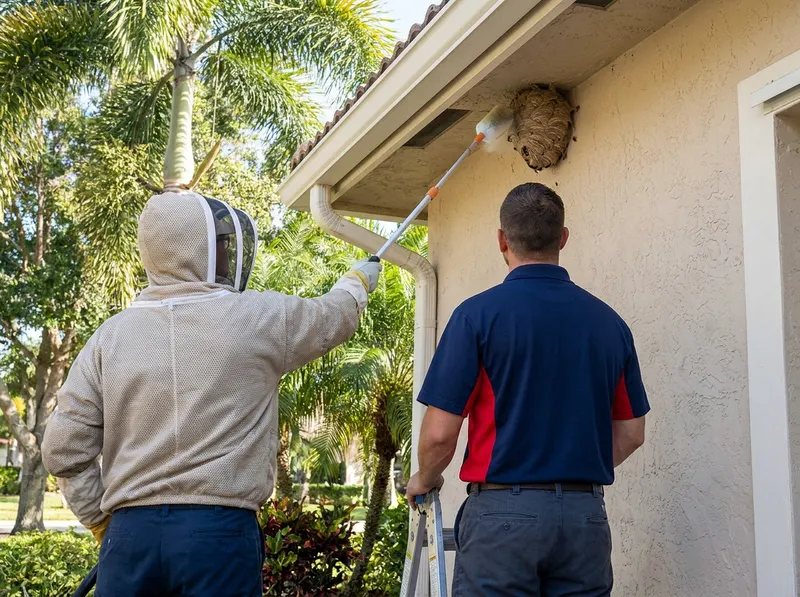
Stinging insect removal requires immediate species determination to separate low-risk solitary species from high-risk eusocial colonies. In coastal South Florida, prolonged 90-degree summer heat and high relative humidity accelerate reproductive rates for paper wasps and bald-faced hornets. Nests constructed beneath barrel tile roofs in El Cid or under deep architectural eaves in Flamingo Park expand from initial hexagonal cells into multi-tiered structures containing hundreds of territorial workers within several weeks. According to entomological identification resources from the University of Florida IFAS Extension, southern yellowjackets frequently excavate expansive subterranean voids in moist sandy soils, turning standard turf maintenance around residential lawns into serious stinging incidents. Over-the-counter pyrethroid aerosols often fail because light sprays disperse the colony across attic vents rather than neutralizing the reproductive queen, escalating aggression toward family members or seasonal tenants.
Technicians from SecureHive Pest Management deploy micro-encapsulated formulations and high-expansion insecticidal foams matched to guidelines from the U.S. Environmental Protection Agency. Ground-nesting yellowjackets along the hedge perimeters of Grandview Heights and Providencia Park receive sub-surface direct injections that saturate the entire underground matrix, preventing defensive swarming. Elevated wasp harborage on historic two-story residences in Northwood Village and Southland Park requires pole-mounted pressurized micro-dusters paired with full-body sting shields adhering to OSHA personal protective equipment standards. Honeybee extractions differ fundamentally from wasp eradication: feral honeybee colonies establishing harborage in architectural wall cavities require structural void opening, complete comb removal to avoid secondary bacterial rot, and adherence to the Florida Department of Agriculture and Consumer Services guidelines governing apiary management.
Property owners evaluating treatment options must weigh localized mechanical removal against whole-structure exclusion seals. Spot knockdown treats visible clusters on exterior gutters, but failing to seal architectural openings lets future foundress queens recolonize identical fascia points within thirty days. Homes situated near water retention zones in the Villages of Palm Beach Lakes, heavily wooded lots in Breakers West, and coastal breezes in the SoSo (South of Southern) corridor experience intense seasonal insect traffic. Sustainable protection pairs immediate perimeter suppression with physical exclusion sealing using heavy wire mesh under roof joints, following structural defense methodologies established by the Pest Control Technology publication. All chemical treatments utilize low-volatility active ingredients selected to minimize indoor transfer, keeping companion animals secure while eliminating target colonies.
Execution follows an objective operational progression: 1. A visual diagnostic scan maps the exact entry fissure, colony flight trajectory, and species nesting material. 2. A calibrated targeted application neutralizes guard insects and the internal nest nucleus within ten to fifteen minutes. 3. Technicians mechanically scrape down and remove the brood combs, followed by an application of residual botanical repellent to break the existing aggregation pheromones. 4. Sealant fills void apertures larger than one-quarter inch. Technicians confirm clearance before leaving the premises, ensuring outdoor living spaces return to a safe, sting-free state without locking homeowners into recurring service contracts.
Every job gets a firm, written price after a free on-site visit.
For standards, safe disposal, and service guidance on pest control services in West Palm Beach, FL, useful references include U.S. EPA, ENERGY STAR, U.S. Dept. of Energy, Consumer.gov, U.S. Census Bureau, and Google Maps. General consumer and small-business resources are available from USA.gov, Better Business Bureau, FTC Consumer Advice, U.S. Small Business Administration, and Ready.gov.
Tell us about your stinging insect removal job in West Palm Beach and we'll send a clear, written quote, usually the same day.
 SecureHive Pest Management